What if every David Bowie recording was deleted tomorrow?
Not banned. Not burned. Just gone. The platform that hosted it was acquired. The server bill went unpaid. An algorithm decided Ziggy Stardust didn’t meet community guidelines.
What if Johnny Cash disappeared the same way?
What if Nina Simone’s recordings, her voice, her protest, her defiance, vanished because a streaming service went bankrupt and nobody thought to back up the catalogue?
What if Martin Luther King’s I Have a Dream was lost forever. Not destroyed by a regime. Just quietly deleted by carelessness, corporate restructuring, and a 30 day grace period nobody noticed.
This is not science fiction. This is how digital storage actually works.
There is no enforceable archival standard for recorded cultural work. None. TIFF exists for images. PDF/A exists for documents. Nothing exists for audio, video or recorded speech. Culture right now survives on subscription payments, corporate goodwill, and servers somebody has to keep paying for.
In an era where algorithms decide what is acceptable, where venture capital buys and strips cultural platforms, where governments pressure companies to delete inconvenient voices, that is not good enough.
I know this personally.
I released music on vinyl for years. I watched that scene change from something carefully curated into something parasitic, shrinking, no longer reaching people the way it once did. So I moved to digital. The quality is better. You are working from the master files. But one question followed me for decades. What happens when the music just disappears?
Then it almost happened to me.
A credit card error locked me out of my own account. No way to update my details. No human support anywhere. AI agent only. My entire catalogue was scheduled for deletion in 30 days and there was nothing I could do. I sat there watching a countdown on work I had spent years creating. It took letters to a CEO, a public social media campaign, and months of fighting just to recover music that was mine.
If it can happen to me it can happen to anyone. And for the voices that matter most, the dissidents, the marginalised, the historically significant, the stakes are infinitely higher.
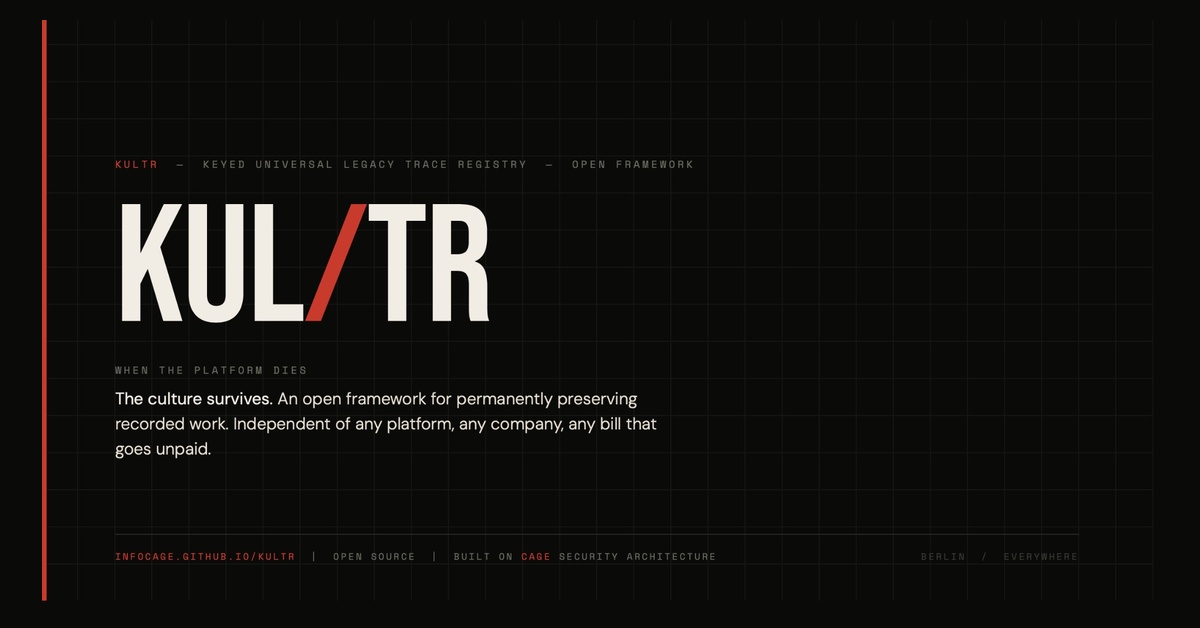
So I built KULTR. Keyed Universal Legacy Trace Registry.
An open framework for permanently preserving recorded cultural work. Music, speech, video, digital art. Independent of any platform, any company, any ideology, any unpaid bill. Decentralized. Quantum resistant. Anonymous submission with future ownership claim. No single entity controls it. No plug to pull.
The Library of Congress has a preservation mandate. UNESCO has a preservation mandate. Neither has a universal open standard to implement it with.
Until now.
This is v0.1. Live today. Open source. Free to implement. Attribution required.
Visit the KULTR Framework: https://infocage.github.io/kultr
Vinyl survives without permission. Culture should too.
KULTR — When the Platform Dies, the Culture Survives